Products and architecture

Knoedge Intelligent Enterprise Fabric

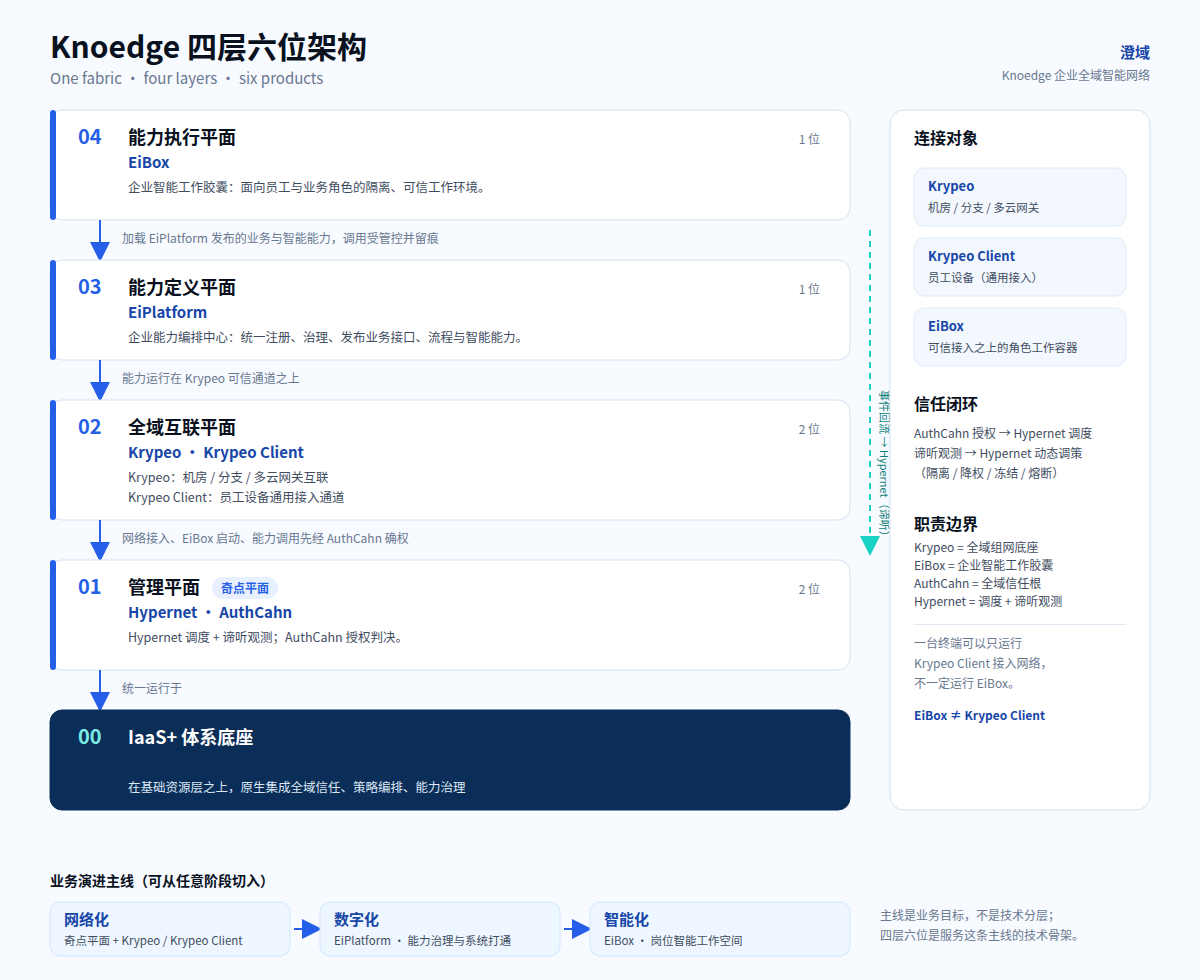
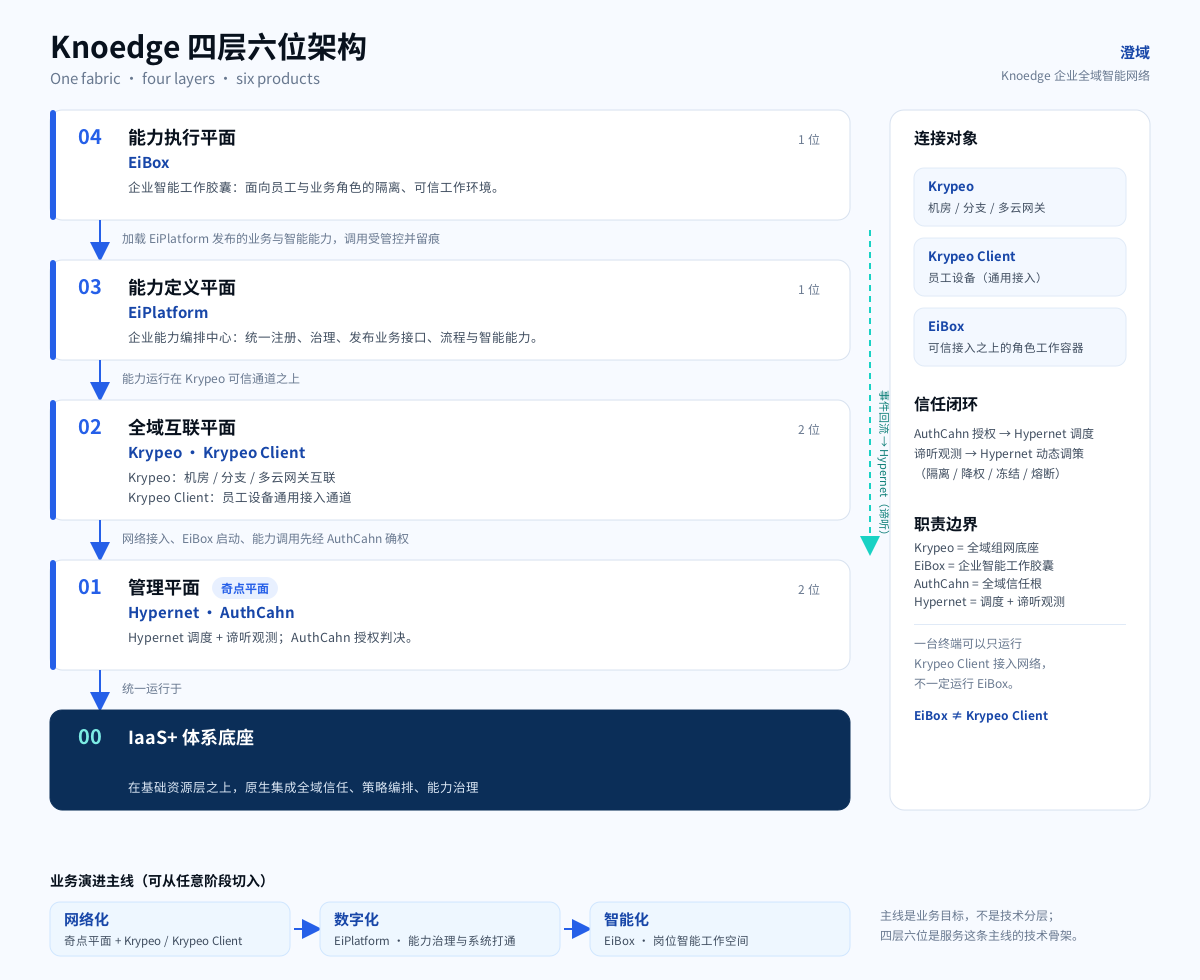
Knoedge uses Singularity as the top-level methodology and IaaS+ as the foundation, governed by the Singularity plane (Hypernet + AuthCahn). Krypeo builds an autonomous trusted mesh for sites, multi-cloud, and edge interconnection; Krypeo Client provides endpoint access; EiPlatform orchestrates enterprise capabilities; EiBox provides intelligent work capsules for employees and business roles. Four layers, six products: network access, session access, and capability calls are governed and audited end to end.

Architecture

Four layers, six products, one fabric

With Singularity as the methodology and IaaS+ as the foundation: the Singularity plane governs, the fabric interconnection plane connects sites and endpoints, EiPlatform defines capabilities, and EiBox provides role-based work environments.

Krypeo connects data centers, branches, and multi-cloud gateways; Krypeo Client connects employee devices; EiBox is a role-based work container above trusted access; DiTing is built into Hypernet, collects all events, and returns anomalies to Hypernet; AuthCahn only outputs authorization decisions.

KrypeoData centers / branches / multi-cloud gatewaysKrypeo ClientEmployee devices (general access)EiBoxRole work container above trusted accessDiTingBuilt into Hypernet · observability, audit, and event return

Products

Six products, one fabric

The Singularity plane sets order, the Krypeo unified mesh connects the fabric, EiPlatform defines capabilities, and EiBox hosts employee and business collaboration. Deliver independently, combine as needed.

Singularity plane · Orchestration

Hypernet

Global orchestration hub

Global policy orchestration, traffic scheduling, business coordination, and fabric-wide governance; built-in DiTing collects full-fabric events and drives dynamic response.

  • Global policy orchestration
  • Traffic scheduling
  • Fabric-wide governance
  • Built-in DiTing observability

内置 · DiTing · Fabric-wide observability and audit engine

DiTing is the observability and audit capability built into Hypernet. It collects, stores, and searches all fabric events: site interconnection, endpoint onboarding, policy delivery, EiBox startup, capability loading, and every business or intelligent capability call. It provides traceability, session replay, anomaly detection, compliance search, and risk alerts; all events are linked to the AuthCahn identity and permission model.

  • Full event collection
  • Traceability and session replay
  • Anomaly detection and alerts
  • Log export to customer SIEM

DiTing does not make permission decisions. When it detects unauthorized or anomalous behavior, events return to Hypernet, which performs session isolation, permission freeze, or traffic circuit breaking — closing the loop: AuthCahn authorizes → Hypernet schedules → DiTing observes → Hypernet adjusts.

Singularity plane · Trust

AuthCahn

Global trust root

Unified identity, roles, and least-privilege policy; decides access, session, and capability-call permissions and outputs the authorization baseline; authorization records flow into the DiTing observation chain.

  • Unified identity
  • Roles and least privilege
  • Permission decisions
  • Authorization records to DiTing
Fabric interconnection plane · Sites and data centers

Krypeo

Autonomous trusted mesh

An autonomous trusted mesh across sites, data centers, multi-cloud, and edge branches, with self-discovery, self-healing, and dynamic traffic scheduling — not an isolated tunnel VPN.

  • Site and data center interconnection
  • Multi-cloud
  • Edge branch access
  • Krypeo Client endpoint channel
Fabric interconnection plane · Endpoint channel

Krypeo Client

General endpoint access channel

A general endpoint access channel: multi-account grouping, network awareness, connection diagnostics, and per-user preset configuration.

  • Windows / Linux / macOS
  • Multi-account and groups
  • Network awareness and auto-connect
  • Diagnostics and preset configuration
Capability definition plane

EiPlatform

Enterprise capability orchestration center

An enterprise capability orchestration center and the orchestration layer for multi-system capability integration: registers, governs, and releases system APIs, automation flows, and intelligent work capabilities, with organization/project isolation, version control, and permission isolation, so authorized roles can call them safely.

  • Capability registry
  • Flow and intelligence orchestration
  • Organization / project isolation
  • Version and permission control
Capability execution · Intelligent work capsule

EiBox

Enterprise intelligent work capsule

An isolated, controllable, trusted work environment for employees and business roles. After the endpoint joins through Krypeo Client, EiBox starts within the AuthCahn permission baseline and loads business and intelligent capabilities released by EiPlatform; it can run on endpoints or servers. It is not an endpoint access channel and does not carry site networking.

  • Isolated workspace
  • Business and AI assistant
  • AuthCahn permission baseline
  • Full audit trail

Methodology

Singularity: stronger as it scales

Plug-and-play nodes, self-forming networking, self-healing topology, and lossless linear scaling. Architecture evolution continues without interruption or business data loss.

Foundation

IaaS+: the shared foundation for all four layers

Native fabric-wide trust, policy orchestration, and capability governance above the base resource layer — different from IaaS that only provides compute and network resources.

Adoption

Evolution path: networking → digital → intelligent

Three stages are a recommended route, not a mandatory order; start wherever your current state fits.

01

Networking

Krypeo + Krypeo Client build trusted connectivity and endpoint admission.

02

Digital

EiPlatform orchestrates multi-system APIs, data, and processes into reusable capability.

03

Intelligent

EiPlatform + EiBox work together to deliver capability to roles.

Stages are business goals, not product groups; the four layers and six products are the technical skeleton.

Deployment

Deployment and boundaries

Bypass deployment without changing the existing network; prove value first, then expand by site, system, or department.

Bypass deployment

Knoedge uses bypass access as the primary deployment mode, without forcing changes to existing routing or replacing firewalls and border security devices; hybrid deployment is also supported.

Keep existing investments

Knoedge does not replace leased lines, SD-WAN, identity sources, or business systems; it layers a unified mesh, identity, and capability plane on top.

Expand incrementally

Start with one site, one system, or one department, then scale with the same operating model.

Delivery: the Krypeo management plane and site side support software deployment and offline installation; Krypeo Client covers Windows, Linux, and macOS; EiBox ships as a desktop client (Linux first) and can also run on servers as a role workspace. Hardware forms and HA/DR options are confirmed per engagement.

Positioning

How it relates to other approaches

Knoedge is not another point VPN or application gateway. On a trusted foundation (Hypernet + AuthCahn), it evolves from networking to digital to intelligent operations: trusted networking, multi-system integration, and role-level intelligence under one control plane, with entry at any stage.

DimensionKnoedgeIPsec VPNSD-WANZTNAAI agent platform
Core roleIntegrated trusted enterprise foundationPoint-to-point / site-to-site encrypted tunnelsMulti-link path selection and optimizationApplication-level zero-trust accessApplication-layer intelligent orchestration
CoverageSites, branches, clouds, endpointsBetween sites or gatewaysBranches and WAN linksApplications and usersApplications and data
Identity and permissionsNative unified identity, permission orchestration, auditNetwork credentials and certificatesLink and policy orientedApplication access policyPlatform accounts and permissions
Endpoint accessKrypeo ClientClient or gatewayUsually site sideLightweight client or browserNot covered
AI capabilityEiPlatform defines, EiBox executesNot coveredNot coveredNot coveredAgent orchestration without a network and identity foundation
DeploymentBypass overlay, incrementalGateway peeringLink replacement or overlayApplication-side proxyApplication-side deployment
Evolution coverageNetworking → digital → intelligent, start anywhereMostly networkingDigital but lacks a trusted networkMostly application accessJumps to intelligence without a trusted foundation

These are positioning differences, not replacements; Knoedge can coexist with existing leased lines, SD-WAN, IAM, ZTNA, and AI agent platforms.

Reliability

Availability, DR, and upgrades

Production engineering capabilities described within each component's actual boundaries.

Control plane

The Singularity plane supports clustered HA; Hypernet supports single-node, multi-node, clustered, and tiered deployment; AuthCahn supports production-grade HA and DR.

Network plane

The Krypeo mesh supports link self-discovery and self-healing; a management-plane failure does not affect established VPNs; state sync, full audit, metrics, and scheduled backups keep operations observable.

Upgrades and rollback

Gray releases support upgrades with no perceived business interruption; Krypeo versions are verifiable and failed deployments can be retried; EiPlatform installer/upgrader supports rollback.

Boundary: Krypeo management-plane HA, multi-tenancy, and inter-domain peering are still maturing; specific HA/DR options are confirmed per engagement.

Security

Security and compliance

Identity, authorization, transport, isolation, and audit form a verifiable loop; certification status is stated only when actually obtained.

Identity and admission

Unified identity federation and trusted admission with OIDC, SAML, and Kerberos, plus password, OTP, WebAuthn, and X.509 authentication.

Authorization and approval

ReBAC fine-grained authorization with approval for sensitive grants, expiry, periodic review, and overdue alerts.

Transport and isolation

Sites and endpoints join through an encrypted trusted mesh based on PKI and certificates; EiBox isolates sessions, certificate trust, and runtime by domain; inter-platform traffic is encrypted.

Audit and traceability

Site onboarding, endpoint access, EiBox startup, and capability calls are recorded end to end. Retention and archiving are configurable and logs can be exported to customer SIEM.

Capability description only, not a compliance certification claim; certification status is stated only when actually obtained.

FAQ

Frequently asked questions

Quick answers on the Singularity plane, IaaS+, component boundaries, and deployment.

What is the difference between Singularity and the Singularity plane?

Singularity is the methodology: plug-and-play nodes, a self-forming and self-healing mesh, and linear scaling. The Singularity plane is the management plane formed by AuthCahn + Hypernet, responsible for fabric-wide order, identity, permissions, and audit.

What is IaaS+?

IaaS+ is the 00-layer foundation: it natively adds fabric-wide trust, policy orchestration, and capability governance above base resources, unlike IaaS that only provides compute and network resources.

How do Krypeo and Krypeo Client relate?

They are two products. Krypeo is the management plane for sites, addressing, policy, and operations. Krypeo Client is the endpoint access client that makes endpoints nodes of the same mesh.

Is EiBox a network device or an AI assistant? What is its boundary with Krypeo?

EiBox is an enterprise intelligent work capsule, not an edge access box, network node, or site gateway. Krypeo Client connects an endpoint to the trusted mesh; EiBox runs inside an already trusted environment and loads capabilities released by EiPlatform. An endpoint can run Krypeo Client without EiBox.

How is EiPlatform different from an LLM or agent platform?

EiPlatform is an enterprise capability orchestration center. It registers, governs, and releases system APIs, automation flows, and intelligent capabilities with version and permission controls. It does not train models or act as a general agent platform.

Must we replace existing VPN, SD-WAN, or identity systems?

No. Knoedge uses bypass overlay, keeping existing leased lines, SD-WAN, identity sources, and business systems while adding a unified mesh, identity, and capability plane on top.

What are the four layers and six products?

Management plane (Singularity plane) 2 products: Hypernet and AuthCahn; fabric interconnection plane 2 products: Krypeo and Krypeo Client; capability definition plane 1 product: EiPlatform; capability execution plane 1 product: EiBox. Six products across four layers, all governed by the Singularity plane.

What is an autonomous trusted mesh?

Sites, data centers, multi-cloud, and edge branches become part of one topology on joining, with self-discovery, self-healing, and dynamic traffic scheduling. Krypeo carries sites and Krypeo Client carries endpoints, unlike an isolated tunnel VPN.

What is DiTing? Is it a separate product?

DiTing is the observability and audit engine built into Hypernet, not a seventh component. It collects site, endpoint, EiBox, and capability-call events and provides traceability, session replay, anomaly detection, log search, and alerts. It does not make permission decisions; anomalies return to Hypernet for isolation, downgrade, or circuit breaking.

Does Knoedge replace firewalls or SIEM?

No. Knoedge is an overlay infrastructure foundation and does not replace firewalls, SIEM, log platforms, or business systems; DiTing audit logs can be exported to existing SIEM and security platforms.

Can we buy only part of the capability?

Yes. Delivery can be split into trusted networking only (Singularity plane + Krypeo + Krypeo Client), networking plus capability platform (add EiPlatform), or the complete foundation (add EiBox). You can also start from the intelligent stage on top of existing trusted access.

What deployment forms are supported? Can EiBox run on a server?

The Krypeo management plane and site side support software deployment and offline installation; Krypeo Client covers Windows, Linux, and macOS; EiBox ships as a desktop client and can also run on servers.

We already have an intranet and systems. Can we start with role intelligence?

Yes. Start from the intelligent stage: use your existing trusted access, deploy EiPlatform and EiBox, and deliver business and intelligent capabilities to roles under permission control, without replacing the existing network first.

Next step

Start with one scenario

Prove value with one site, one system, or one department, then expand as needed.